

What If Every Student Built a Personal Learning System Before Graduation?
The second brain for the AI era and a new way to think about the value of college.

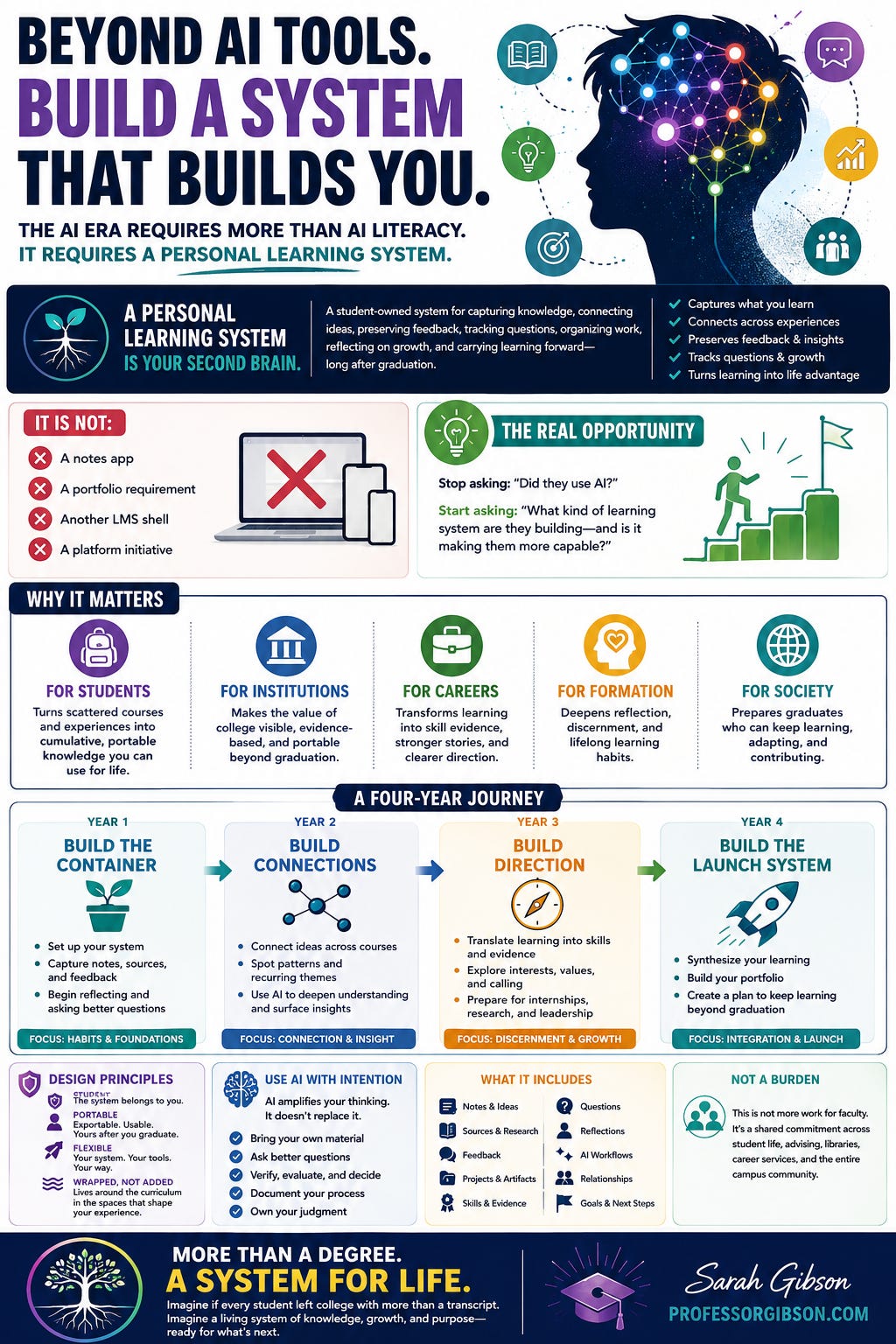
See the TL;DR infographic at the bottom.
Higher education is having an AI moment.
But not just because students can now use powerful tools to write, summarize, code, research, tutor, and create. It is an AI moment because students need something most have never been taught to build:
a personal learning system.

Think of it as a second brain.
Not a notes app.
Not a portfolio requirement.
Not another LMS shell.
Not a platform initiative.
A personal learning system is a student-owned structure for capturing knowledge, connecting ideas, preserving feedback, tracking questions, organizing work, reflecting on growth, and carrying learning forward.
It helps students turn scattered courses, assignments, conversations, and experiences into something cumulative.
Something portable.
Something they can use after graduation.
In an AI-shaped world, this may become one of the most important things a student builds in college.
The real opportunity
Most of the AI conversation in higher education has focused on whether students should be allowed to use AI.
Did they use it?
Did they disclose it?
Did it cross a line?
Can we detect it?
Can we regulate it?
Those questions matter, but they are not big enough.
The better question is:
What kind of learning system is this student building, and is that system making them more capable?
Because students are already building systems.
Some are intentional. Many are accidental.
They have systems for saving notes, finding answers, managing deadlines, asking AI for help, drafting papers, studying for exams, storing files, texting classmates, remembering feedback, and getting through the semester.
But many of those systems are fragmented, invisible, short-term, and built around completion rather than formation.
They are designed to survive a course.
Not to build a life.
A personal learning system changes the frame.
It says college should not only give students access to content, faculty, courses, and credentials. It should help them build the infrastructure to make meaning from those experiences. Lifelong connections.
Why this matters for the institutional value proposition
This is where the idea becomes much bigger than AI literacy.
Higher education’s value proposition is under pressure. Families, students, boards, employers, and policymakers are asking what students actually leave with.
A transcript shows what students completed.
A diploma signals that a credential was earned.
But neither one fully captures what students learned, how they changed, what feedback shaped them, what questions they carried, what projects formed them, what relationships mattered, or how their thinking developed over time.
A personal learning system helps make the value of college visible and portable.
Students would not leave only with grades, credits, and scattered artifacts buried in old course shells.
They would leave with a living system that contains the accumulated evidence of their learning.
Their best work.
Their strongest questions.
Their faculty feedback.
Their research trails.
Their internship reflections.
Their skill evidence.
Their AI workflows.
Their ethical decision points.
Their intellectual connections.
Their emerging sense of direction.
That strengthens the value proposition of the institution because it helps students preserve and compound what the institution makes possible.
College is not valuable only because students encounter information. Information is abundant.
College is valuable because students encounter people, disciplines, feedback, communities, practices, traditions, challenges, mentors, and moments of formation.
But if those encounters are not captured, connected, reflected on, and carried forward, much of their value dissipates.
A personal learning system gives students a way to carry the institution’s impact with them.
Not as nostalgia.
As usable knowledge.
As evidence.
As direction.
As a system for life.
This cannot become a platform initiative
The fastest way to ruin this idea would be to turn it into a platform rollout.
If the institutional response is, “Great, let’s buy a product and require every student to use it,” the idea will shrink immediately.
This cannot become another dashboard.
It cannot become another compliance checkbox.
It cannot become another software adoption campaign.
The point is not the platform.
The point is the habit, the structure, and the student’s ownership of their own learning.
Institutions can provide templates, examples, coaching, recommended tools, and export guidance. They can help students understand what a good system includes. They can support students in building something usable and sustainable.
But the system itself has to belong to the student.
That means it must be portable.
It must be exportable.
It must be flexible.
It must be usable after graduation.
It must not be trapped inside a learning management system the student loses access to when they leave.
If higher education says it believes in lifelong learning, then students need learning systems they can carry into life.
This cannot become one more thing placed on faculty
The second fastest way to ruin this idea would be to make it a faculty burden.
Faculty are already carrying too much. If this becomes “every faculty member must redesign their course around student second brains,” it will fail before it begins.
This should not sit primarily inside the course structure.
It should wrap around the learning.
It should live in the spaces between and around the curriculum: student life, advising, first-year experience, career development, academic support, libraries, honors programs, residence life, athletics academic support, chapel or formation programs, and leadership development.
It should move through the institution like water.
Around the nooks and crannies.
Not as a new academic requirement dropped into every syllabus, but as a bridge that helps students connect what is already happening.
Faculty can contribute through small touchpoints, but they should not have to own the entire structure.
A professor might ask students to save one key insight from a course.
Or reflect on one piece of feedback.
Or connect a reading to something learned in another class.
Or identify a skill demonstrated by a major assignment.
Those are valuable contributions.
But the larger system should be supported outside the traditional course structure.
This is a student formation project, not just an instructional design project.
What it could look like over four years
Imagine a four-year bridge experience that helps every student build a personal learning system alongside their degree.
Not a course.
Not a major.
Not a one-time workshop.
A recurring thread.
Year One: Build the container
Students learn how to create a basic personal learning system.
They set up spaces for courses, notes, sources, feedback, questions, projects, skills, reflections, relationships, AI use, and future goals.
The focus is simple:
Capture what matters.
Keep what you may need again.
Begin seeing college as something you are building, not just something you are completing.
Year Two: Build connections
Students begin connecting ideas across courses and experiences.
They ask:
Where have I seen this idea before?
What questions keep returning?
What feedback have I received more than once?
What themes are emerging in my work?
How does one class connect to another?
This is where AI can become especially useful, not as a replacement for thinking, but as a tool for surfacing patterns from the student’s own material.
Year Three: Build direction
Students use their system to prepare for internships, research, leadership roles, study abroad, service, graduate school, or career exploration.
They begin translating learning into evidence.
What skills have I built?
What examples prove it?
What projects show my growth?
What problems do I care about?
What kind of work gives me energy?
What values are becoming visible in my choices?
Their personal learning system becomes a bridge between academic learning and vocational direction.
Year Four: Build the launch system
Students prepare to leave with a system they can keep using.
They create a portfolio of strongest work, a skills evidence bank, a professional narrative, a personal knowledge map, a set of reusable workflows, and a plan for maintaining the system after graduation.
They do not leave only with a transcript.
They leave with a structured record of what they learned, what shaped them, and what they are ready to carry forward.
Why AI makes this urgent
AI increases the need for personal learning systems because AI makes production easier.
Students can generate more words, more summaries, more ideas, more drafts, more outlines, more explanations, and more possibilities than ever before.
But more output does not automatically mean more learning.
Students need systems that help them decide what matters.
What should I keep?
What should I question?
What should I verify?
What should I revise?
What should I connect?
What should I ignore?
What decision still belongs to me?
Without a system, AI can become a stream of disconnected assistance.
With a system, AI can become part of a larger practice of learning, reflection, and judgment.
This also gives institutions a much better way to talk about responsible AI use.
Instead of only asking, “Did you use AI?” we can ask:
How did AI support your learning system?
What did you bring to the tool?
What did you verify?
What did you reject?
What did you learn from the process?
How did your judgment shape the final work?
That is a richer educational conversation.
The privacy and ownership questions matter
This idea also raises real ethical and practical questions.
Who owns the system?
Where does it live?
What should students never put into it?
What happens after graduation?
Can the student export it?
Can the institution see it?
Can faculty or advisors access any part of it?
How does AI interact with the material inside it?
What happens when personal reflection, academic work, advising, and career preparation begin to overlap?
These questions should not be treated as technical afterthoughts.
They are central to the design.
A personal learning system should not become a surveillance system.
It should not become a hidden assessment database.
It should not become another way for the institution to extract student data.
The system has to be built around student agency.
Students should control what is private, what is shared, what is submitted, and what is carried forward.
That is part of the educational value.
They are not only learning how to organize knowledge.
They are learning how to steward it.
The assessment risk
There is another danger.
If institutions over-assess the personal learning system, students will perform it instead of use it.
That would defeat the purpose.
The system should not become a polished artifact students maintain for institutional approval.
It should not become a graded scrapbook.
It should not become a compliance portfolio where students upload evidence because someone told them to.
There may be moments where students draw from the system for reflection, advising, portfolio review, capstone work, career preparation, or program assessment.
That could be powerful.
But the personal learning system itself should remain primarily student-owned and student-used.
The institution can assess selected reflections or synthesized artifacts.
It should not try to grade the whole inner architecture of a student’s learning life.
The equity question
This idea also has an equity dimension.
Some students already know how to build systems. They arrive with strong executive functioning skills, digital fluency, family guidance, academic confidence, and access to tools.
Other students are trying to survive the week.
If institutions simply say, “Build a second brain,” the students who need the most support may benefit the least.
That is why the model has to be scaffolded.
Simple starting structures.
Low-friction tools.
Clear examples.
Repeated support.
Short workshops.
Peer mentors.
Advising integration.
Immediate usefulness.
Students need to see how the system helps them now, not just someday.
It should help them study for the exam this week. Prepare for the advising appointment next month. Remember the feedback from the last paper. Find the source they used in a previous class. Build a stronger resume. Ask better questions.
Use AI more effectively because they have better material to bring to it.
The long-term vision is a system for life.
But the system has to be useful in the ordinary pressure of student life.
The bigger claim
For years, higher education has promised lifelong learning.
But lifelong learning requires more than access to courses.
It requires habits, structures, memory, reflection, feedback, judgment, and continuity.
In the AI era, those things matter even more. Students do not only need to know how to use AI. They need to know how to build systems around AI that make them more capable, not more dependent.
That is the opportunity in front of higher education.
Not another app.
Not another platform.
Not another mandate.
A personal learning system students build over time, with guidance, support, reflection, and ownership.
A system that helps them gather the pieces of their education and learn how to carry them.
Imagine if every student spent four years building that alongside their degree.
They would leave with more than a transcript.
They would leave with a customized second brain: a living knowledge system filled with what they learned, the questions they asked, the feedback they received, the projects they built, the relationships that shaped them, and the connections they made across the institution.
Not just evidence that they completed college.
A system they could use for life.
I like this a lot...it's really a distinct genre that's less about assessment and more about fostering life long learning
LOVE THIS!! I full agree with your statement "The fastest way to ruin this idea would be to turn it into a platform rollout." So true, the whole point of AI is we each build our own setup that works for us. I always say,the truth is that the way I use Claude and the way someone else uses Claude is very different. We each use Claude to build our own system that works for us, and I fully agree that students need to do the same, and they may not use Claude. They may use notebookLM or something else. Every student will find the tools and the systems that work for them. Our job is to help them work through the system, and I love how you laid that.