

Mother Nature, Human Judgment, and the Limits of AI Compassion
What an ice storm, my students, and the limits of AI reminded me about judgment

Nashville is hurting this week.
Many of my students have been without power for nearly three days, sitting in freezing temperatures, navigating uncertainty, and just trying to get through the basics of daily life. The campus has been impacted, too.
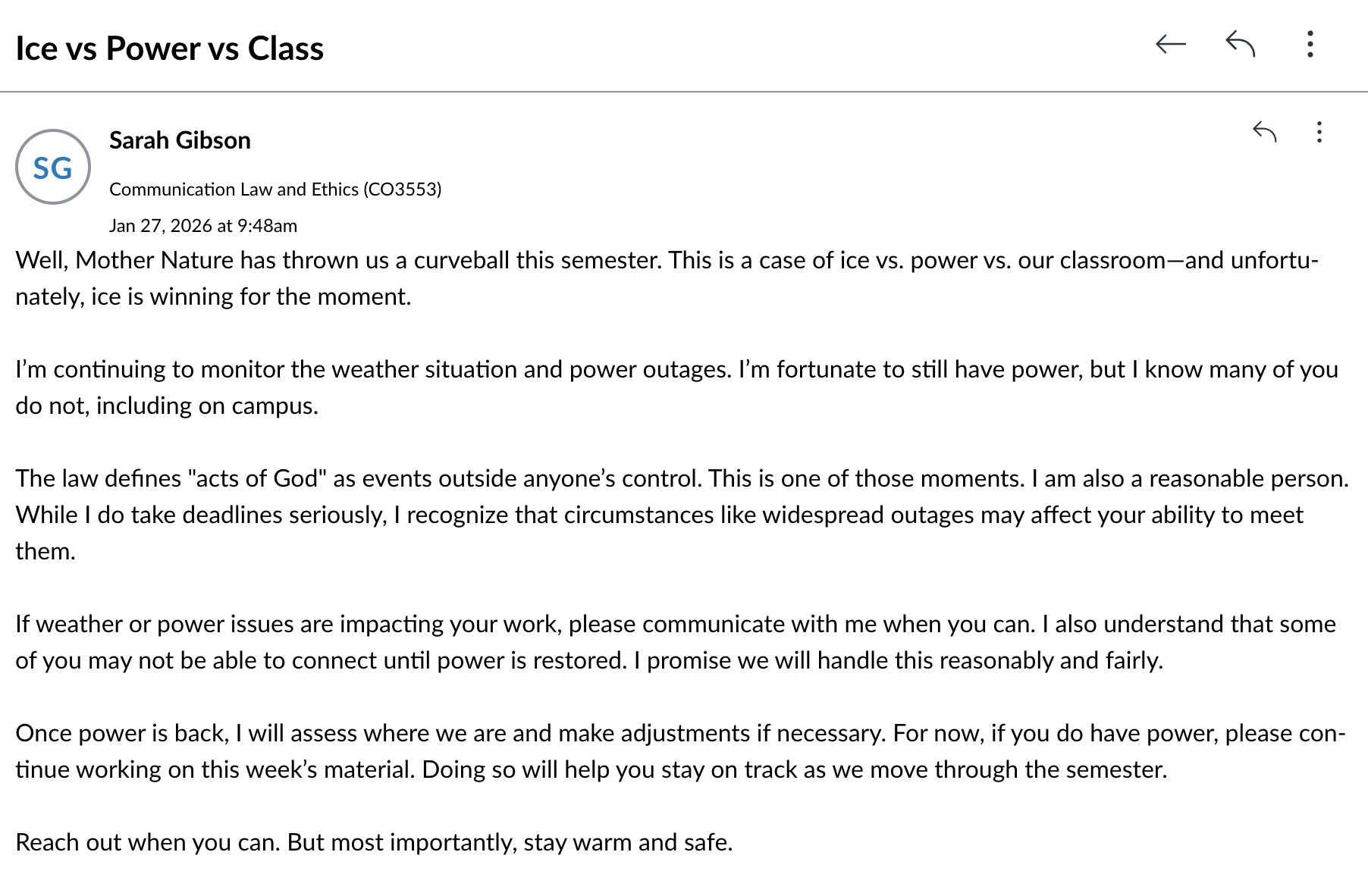
This morning, I sent my Communication Law and Ethics class a message explaining how the law defines “acts of God,” events outside anyone’s control, and why this moment qualifies. I reminded them that while deadlines matter, so does reasonableness.
What struck me afterward is this: Even in the middle of a disaster, I can’t help but see a teaching moment.
Recently, someone asked me whether AI could eventually start deciding legal cases.
Moments like this are exactly why judgment is best left to humans.
AI can process rules. It can summarize precedent. It can surface patterns.
But it cannot feel the weight of a city without power, students shivering in their apartments, or the ethical responsibility of responding with fairness when the world breaks the routine.
This is one of the things AI can’t do, and why humans working with AI will always be better than AI working alone.
Law isn’t just rules on paper. It’s discretion. It’s context.
It’s knowing when to hold firm and when to make space.
Once a professor, always a professor, even when the classroom looks like an ice storm, a power outage, and a city doing its best to take care of its own.
Thinking especially of our students, families, and neighbors who are still cold and waiting for the lights to come back on. 🤍
Praying for you, your students, and the Nashville community!