

AI Thunderstorms Are Here: Learning to Lead When the Weather Won’t Clear
Why institutions need more than one-time training to build real AI readiness.

Thunder has been rolling through Nashville for the past four hours.
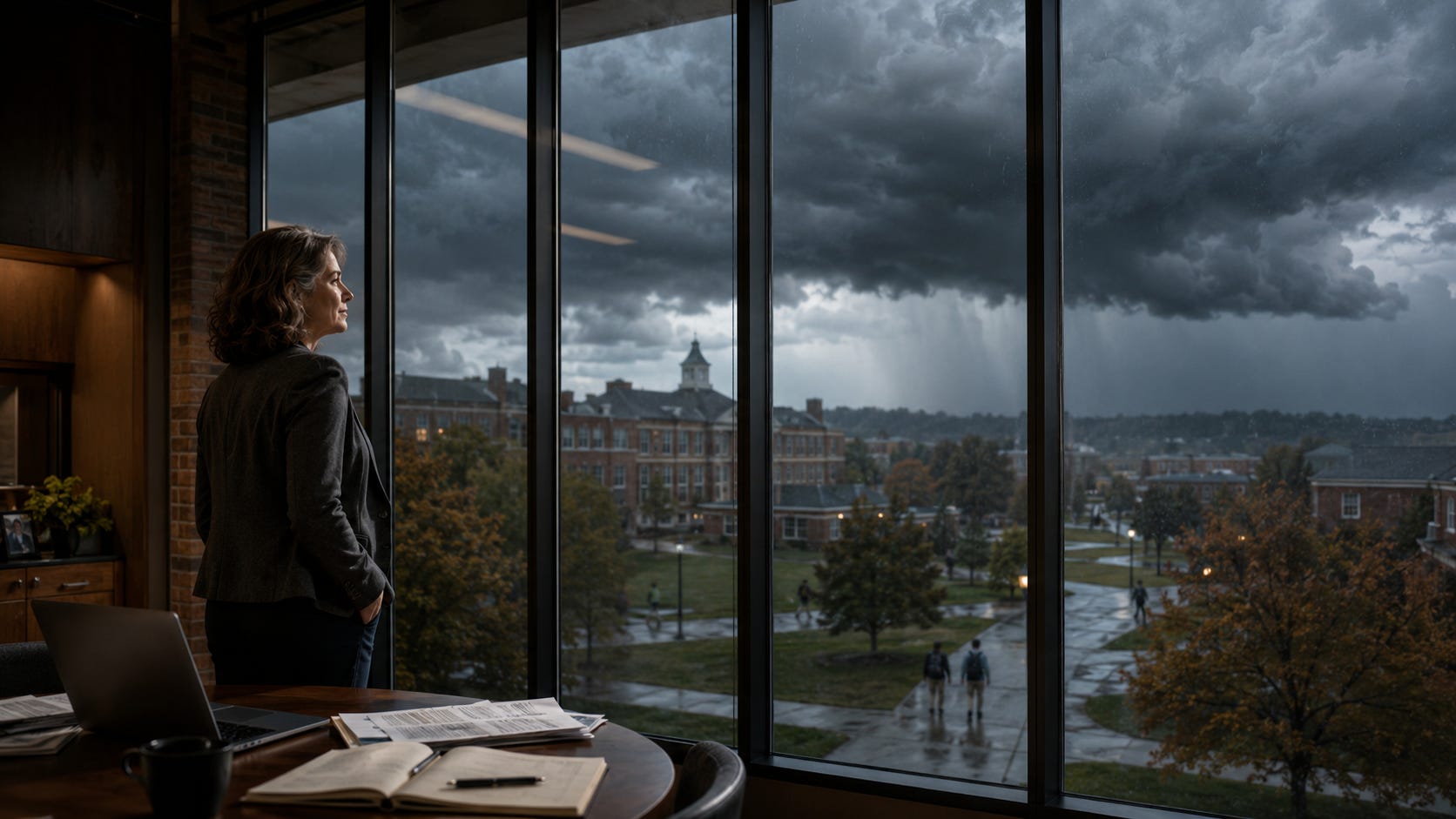
The kind of thunder that interrupts your thoughts and shakes your house. The kind of lightning that makes you look up from whatever you were doing. The kind of weather that is hard to ignore.
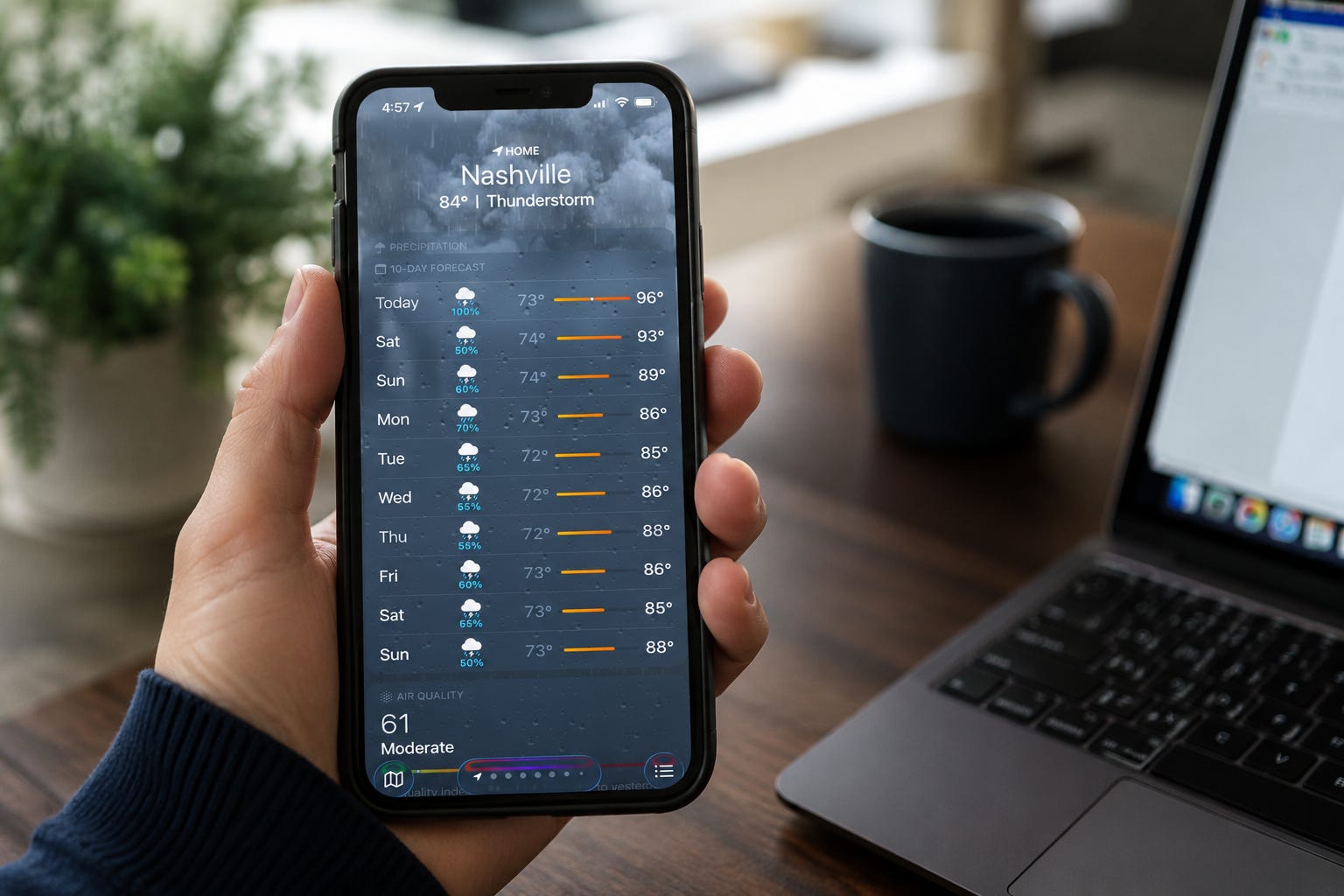
When I checked the forecast, I noticed thunderstorms for the next ten days.
And honestly, that feels like the AI forecast right now.
Not one storm. A pattern.
I think that is where many institutions are getting stuck.
We keep talking about AI as if it is a storm on the horizon. But it is already here. Faculty are already teaching through it. Students are already using it. Staff are already making choices about it. Leaders are already feeling the pressure of decisions they cannot delay forever.
We are still hoping for clear skies before we make serious decisions about AI. We want clear policies, clear tool guidance, clear classroom norms, clear answers about assessment, clear boundaries around student use, and clear direction about what is changing next.
That desire makes sense. Leaders are trying to be responsible. Faculty are trying to protect learning. Staff are trying to understand what is safe, what is allowed, and what is worth their time. No one wants to build a strategy on unstable ground.
But the forecast may not clear anytime soon.
AI is not a one-time storm. It is a changing weather system.
Institutions need more than one-time training, isolated responses, or another stack of information. They need a system for helping people learn, adapt, and keep moving.
A real learning system.
One that helps people build judgment.
One that gives faculty shared language.
One that helps leaders make decisions before every question becomes a crisis.
One that treats AI literacy as ongoing formation, not a single training event.
If the weather has already changed, institutions need to get better at reading the signals.
Here are five shifts that matter right now.
1. Stop waiting for clear skies
A lot of organizations are waiting for AI to “settle down” before they act.
But AI is not showing signs of settling down.
The tools keep changing. The models keep improving. The rules keep evolving. Student behavior keeps shifting. New ethical questions keep appearing.
That does not mean institutions should rush. Caution matters. But caution and stillness are not the same thing.
Wise leadership does not require perfect certainty. It requires the ability to make grounded decisions as conditions change.
Waiting for clear skies can feel safe, but it can also leave people unsupported for too long.
Faculty are already making choices about AI. Students are already using it. Staff are already wondering whether they can use it for everyday work. Departments are already developing informal norms, whether the institution names them or not.
The question is not whether AI is entering the institution.
It already has.
The question is whether people have the structure they need to respond well.
2. AI readiness is storm readiness.
When storms are in the forecast, you do not just buy one umbrella and call it a plan.
You check the radar. You know where to go. You communicate with people. You protect what matters. You adjust plans as conditions change.
AI readiness works the same way.
It requires more than enthusiasm and more than fear. It requires practical infrastructure: shared language, clear expectations, data boundaries, training, escalation paths, examples, reflection, and regular recalibration.
A campus does not become AI-ready because a few people know how to write good prompts.
A campus becomes AI-ready when people across the institution understand enough to make wise decisions in their own context.
That includes faculty deciding how AI fits into assignments. Staff deciding what information should never go into a tool. Leaders deciding which systems are appropriate for institutional use. Students learning when AI supports learning and when it short-circuits it.
Readiness is not just access to tools.
Readiness is the development of judgment.
3. The forecast is not the failure.
A stormy forecast is useful information.
The failure is pretending the skies are clear when everyone can see they are not.
In the AI conversation, I sometimes see institutions avoid naming uncertainty because they do not want to cause fear. But silence does not reduce fear. It often increases it.
People know the weather has changed.
They see students using AI. They see headlines about cheating, automation, bias, hallucinations, job disruption, privacy concerns, and productivity gains. They hear conflicting advice from colleagues, vendors, and social media. They know something significant is happening, even if they do not yet have language for it.
Naming the forecast honestly is not alarmist. It is responsible.
The goal is not to predict every possible storm. The goal is to help people understand the conditions well enough to make better decisions.
That starts with telling the truth.
AI is changing how people write, learn, search, create, assess, communicate, and work.
That does not mean everything is broken.
It means leadership is needed.
4. Faculty are being asked to teach during thunderstorms.
Faculty are not waiting on the sidelines while institutions figure this out.
They are already teaching in the middle of it.
They are redesigning assignments, answering student questions, navigating academic integrity concerns, evaluating AI-generated work, rethinking feedback, and trying to determine what responsible use looks like in their disciplines.
Many are doing this while also managing full teaching loads, research expectations, advising, committee work, accreditation needs, and the ordinary complexity of academic life.
So when we talk about AI readiness, we have to be careful not to make it one more disconnected task.
Faculty do not need vague encouragement to “embrace AI.”
They do not need panic-driven mandates.
They do not need a random parade of tools.
They need structure.
They need examples that respect disciplinary differences.
They need language for talking with students.
They need guidance on privacy, bias, authorship, and academic integrity.
They need space to practice and reflect.
They need support that recognizes both the opportunity and the disruption.
Faculty are not resistant because they are behind.
Many are cautious because they understand what is at stake.
That caution should be treated as wisdom to work with, not a problem to overcome.
5. Every day cannot be an emergency.
When every day looks like a storm, people burn out if the institution stays in crisis mode.
That is one of the risks of the current AI moment.
Every new model release, every viral tool, every student misuse case, every legal update, every vendor pitch can feel urgent. And some things are urgent. But not everything can be treated as an emergency.
If the AI conversation stays reactive, people will either panic or disengage.
Neither leads to readiness.
Institutions need rhythms that help people keep learning without constantly feeling behind.
That may look like recurring faculty development, simple decision guides, departmental conversations, clear “do not enter” data categories, updated assignment language, student-facing expectations, and regular moments to revisit what has changed.
The goal is not to eliminate uncertainty.
The goal is to build enough capacity that uncertainty does not stop the work.
AI leadership is less about carrying the perfect umbrella and more about building a campus that knows what to do when the weather turns.
Because clear skies are not the strategy.
Readiness is.