

AI Graduation Backlash: Why Students Are Booing AI at Commencement
Graduation, AI, and the Crisis of Human Presence

Something is happening at graduation ceremonies across the country.
An event that should have been routine has instead turned into viral controversies, student frustration, public booing, and growing backlash against AI in highly symbolic spaces.
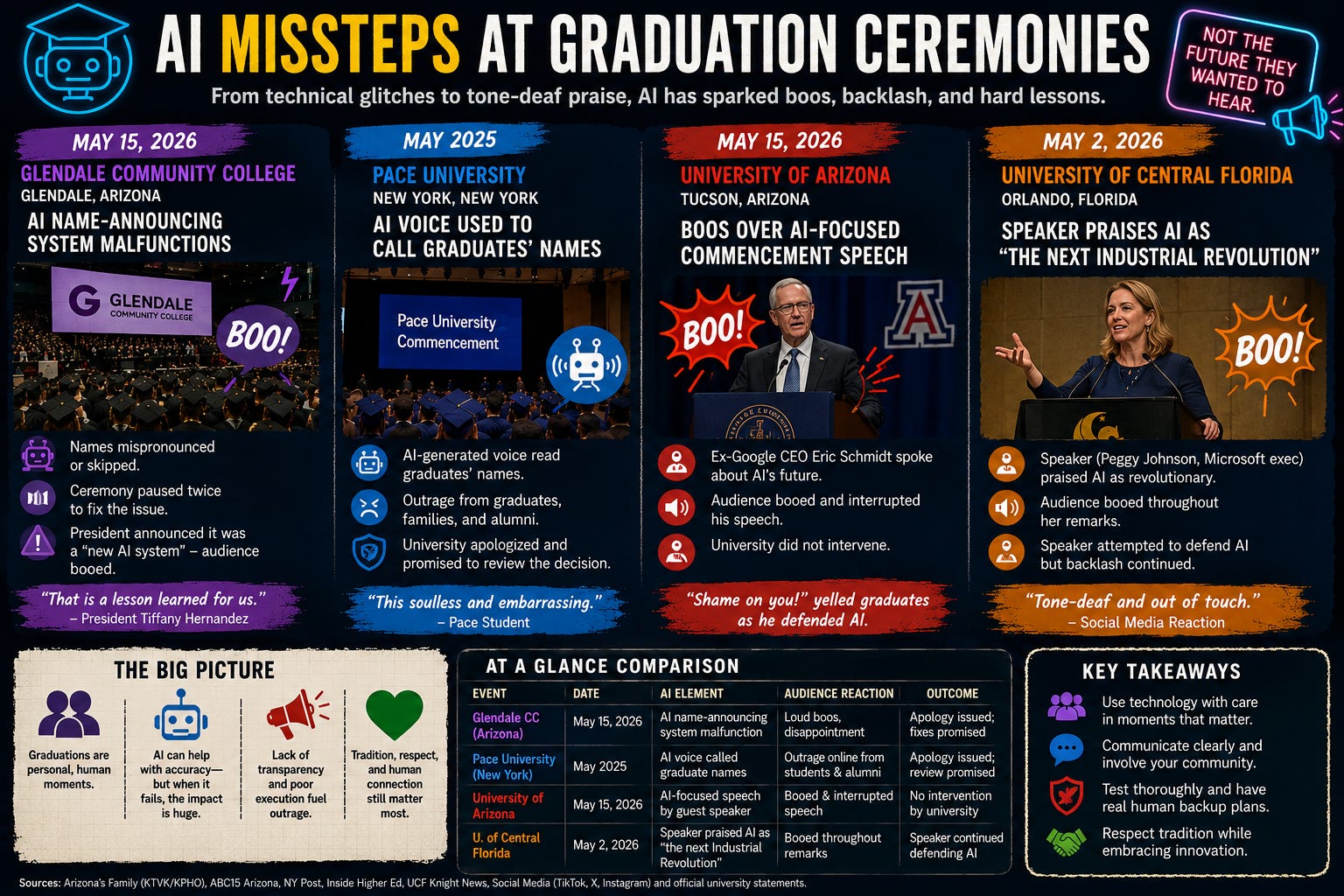
At Glendale Community College, an AI-powered commencement name-reading system malfunctioned during the ceremony. Names were skipped, mismatched, or delayed. When administrators explained the issue involved AI, the crowd booed.
Last year, at Pace University, students reacted negatively after the university used an AI-generated voice system to announce graduate names. Some students described the experience as impersonal and unsettling, comparing it to hearing a GPS system narrate one of the most important moments of their lives.
Also at West Chester University, backlash emerged after students learned AI-generated voice recordings had been used for graduation announcements. University officials later clarified they believed human voice actors were involved in the process, revealing another layer of the problem: institutions themselves are sometimes struggling to understand where AI begins and ends.
And who can forget a few weeks ago, when University of Central Florida students booed a commencement speaker who praised AI as transformative and compared it to the Industrial Revolution. The reaction was not about a technical failure at all. It was emotional. Students facing economic uncertainty and an unstable job market reacted viscerally to optimistic AI rhetoric delivered at the very moment they were graduating into that uncertainty.
Individually, these incidents may look disconnected.
Together, they reveal something important.
Graduation ceremonies have unexpectedly become one of the first major public battlegrounds for cultural AI resistance.
And I do not think that is accidental.
Why Graduation Became the Flashpoint
Commencement is not just another institutional event.
It is a ritual space.
Modern life has very few shared rituals left. Graduation still carries symbolic weight because it publicly recognizes transformation. A student crosses a stage, hears their name spoken aloud, and is acknowledged before a community as someone who has become something new.
That moment is deeply human.
Which is precisely why AI disruptions feel so emotionally charged there.
If an AI system helps optimize warehouse inventory management, few people care. If AI assists with meeting summaries, calendar scheduling, or caption generation, most people barely notice.
But graduation is different because graduation is fundamentally about recognition.
And recognition is relational.
The problem institutions keep running into is that they are approaching these systems primarily as workflow improvements:
faster ceremonies
fewer pronunciation errors
more consistency
smoother logistics
lower staffing strain
But families and students are NOT experiencing graduation as a workflow.
They are experiencing it as meaning.
That gap explains almost all of the backlash.
We Are Watching a Shift in Public Sentiment Toward AI
For the last two years, much of the AI conversation was dominated by awe. People were fascinated by chatbots and image generation. The cultural mood was curiosity mixed with excitement.
But something started to shift in 2025.
The emotional tone around AI is becoming more complicated.
People are no longer simply asking: What can AI do?
They are beginning to ask: What happens to humans if everything becomes mediated through AI?
That is a different kind of question entirely.
The graduation incidents matter because they reveal the early signs of what I think is a broader cultural movement away from pure technological enthusiasm and toward something more defensive and protective.
People are beginning to push back when AI enters spaces they still perceive as fundamentally human.
Not because they are anti-technology.
Because they are trying to protect meaning.
The Real Source of AI Resistance
Much of the current discourse frames AI resistance as fear of job loss or technological confusion.
Those things are real.
But I increasingly think the deeper issue is existential rather than economic.
People are beginning to feel that human presence itself is being compressed.
The modern world has already created exhaustion through algorithmic feeds and constant optimization. AI enters that environment and accelerates it further. Suddenly, customer service becomes synthetic, voices become generated, and conversations become assisted.
And slowly, people begin wondering: Where are the actual humans?
That question sits underneath many of these graduation controversies.
Families do not attend commencement primarily for efficiency.
They attend for humanity.
They want to hear emotion in a voice. They want to witness nervousness. They want the awkward pause, the smile, the stumble, the relief. Even imperfection communicates effort and care.
This is why the Glendale malfunction became symbolic so quickly.
The AI system failed at the exact moment the institution was supposed to recognize individual human beings publicly.
And because the recognition process itself had been automated, the failure felt larger than a technical glitch. It felt like depersonalization.
Institutions Are Misreading the Moment
Many institutions still approach AI primarily through the language of productivity. But the public conversation is increasingly shifting towards trust, dignity, and human connection.
Those are fundamentally different frameworks.
And this is where many organizations are getting caught off guard.
The technical capability exists before the cultural meaning has been negotiated.
Just because AI can perform a task does not mean people will emotionally accept it performing that task.
Especially in symbolic spaces.
Graduation ceremonies simply expose this tension earlier and more publicly than other domains.
The Deeper Educational Question
Higher education now finds itself in an unusual position.
It is simultaneously being pressured to adopt AI rapidly while also being expected to defend deeply human values.
That tension is not going away.
Because AI is not simply changing how institutions operate.
It is changing what society believes should remain unmistakably human.
That is why these graduation mishaps matter more than they initially appear to.
They are not isolated public relations problems.
They are early warning signs that society is beginning to renegotiate the boundaries between automation and humanity.
And the institutions that navigate this moment well will not be the ones that reject AI entirely.
They will be the ones who understand something deeper: In an age of synthetic fluency, human presence becomes culturally precious
I agree with this. But what I find confusing is why it isn’t seen as obvious.
You have named so many important things here! Relational, humanity, the tension, efficiency while protecting what's deeply human... Great post!!!